Friday, 18 July 2025

Understanding about AS4 (Applicability Statement 4)

What is AS4 in EDI?

AS4 (Applicability Statement 4) is a modern secure web services-based communication protocol used for B2B data exchange, especially in EDI (Electronic Data Interchange). It is a successor to AS2, offering enhanced security, reliability, and flexibility using SOAP and web services standards.
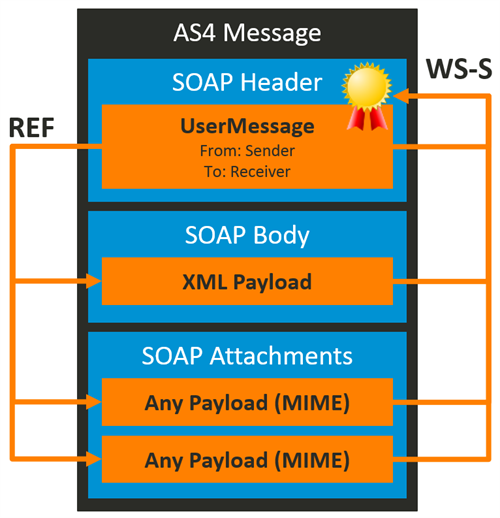


Key Components of AS4 Architecture

Component

Description

SOAP Envelope

AS4 uses SOAP 1.2 for message structure.

ebMS Header

Metadata such as sender, receiver, message ID, and action.

Payload

Can be any type (XML, EDIFACT, X12, etc.).

WS-Security

Ensures message encryption, signature, and integrity.

Reliability

Built-in retry, duplicate detection, and delivery tracking.

P-Mode

Configuration setting that governs how messages are exchanged between partners (like service agreements).

Sunday, 13 July 2025

Understanding about SAP Port Configuration

In SAP EDI/IDoc processing, a port defines how IDocs are sent or received between systems,

Integration Scenarios

  • SAP to SAP

  • SAP to middleware (like Sterling, Boomi, Cleo, SAP PI/PO)

  • SAP to a file directory


Types of Ports in SAP:

Port Type

Description

tRFC (Transaction RFC)

Used for real-time IDoc transmission to another SAP system

File Port

Writes IDocs to a file (e.g., for middleware like Cleo, Seeburger, etc.)

ABAP-PI

Internal communication through ABAP proxy (used in SOA/web services)

XML HTTP

Sends IDocs as XML over HTTP(S)

Directory (EDI)

Sends IDoc to file system (common for outbound interfaces)


Where to Configure:

Use transaction WE21 to configure ports.


Why Port Is Important:

When SAP triggers an IDoc, it uses:

  • Partner profile (WE20)
  • Output type (e.g., BA00)
  • Port (defined in WE21)

If the port is misconfigured or missing, you'll get errors like:

  • Error while writing IDoc to file (EA084)
  • Port does not exist
  • No authorization to write file


Saturday, 14 June 2025

Understanding about AS2 MDN (Message Disposition Notification)

AS2 MDN (Message Disposition Notification):

AS2 MDN is an electronic receipt sent back to the sender after a successful (or failed) AS2 file transmission. It confirms message delivery and ensures non-repudiation (proof of delivery). It's like a return receipt in postal mail, but in the world of secure EDI communication.


AS2 Overview:

  • AS2 (Applicability Statement 2) is a protocol used to securely exchange EDI or other data over the internet using HTTP(S).

  • It supports:

    • Digital signatures

    • Encryption

    • Compression

    • MDN (Acknowledgement receipt)


MDN (Message Disposition Notification)

  • MDN is the acknowledgment that:

    • The message was received

    • The message was decrypted

    • The signature was verified

  • It may also include errors if the transmission fails.

There are two types:

  • Synchronous MDN (returned in the same HTTP connection)

  • Asynchronous MDN (returned in a separate HTTP request)


How Does an AS2 MDN Look?

An AS2 MDN is similar to an email delivery receipt and contains metadata like this:

Sample MDN (Human-readable)

Return-Path: <as2receiver@company.com>
Disposition: automatic-action/MDN-sent-automatically; processed Original-Recipient: rfc822;ReceiverAS2 Final-Recipient: rfc822;ReceiverAS2 Original-Message-ID: <AS2Sender1234@company.com> Received-Content-MIC: Wn5SxvSGz4ksklasdaasdas==, sha1
  • Disposition: indicates success or failure

  • Original-Message-ID: matches the ID of the original AS2 message

  • Received-Content-MIC: Message Integrity Check value


Sample MDN with Error (Failure)

Disposition: automatic-action/MDN-sent-automatically; failed/error: decryption-failed
Failure: The message could not be decrypted with the partner’s certificate.

Why MDN Is Important?

  • Provides non-repudiation of receipt

  • Helps in tracking and troubleshooting

  • Often required in HIPAA, retail, automotive, pharma, etc.

Monday, 26 May 2025

Different Qualifiers in Reference Identification (REF) Segment

In EDI X12, the REF segment (Reference Identification) is used to convey identifying information like account numbers, invoice numbers, customer codes, and other references that relate to the transaction set.

Each REF segment uses a qualifier to indicate what kind of reference is being provided.


Common REF Qualifiers and Their Meanings

Qualifier

Meaning

IA

Internal Vendor Number

BT

Batch Number

CO

Customer Order Number

DP

Department Number

DO

Delivery Order Number

IV

Seller’s Invoice Number

PO

Purchase Order Number

RE

Release Number

SI

Shipper’s Identifying Number for Shipment

TN

Transaction Reference Number

MR

Master Reference (Bill of Lading, etc.)

PK

Packing List Number

ZZ

Mutually Defined

CN

Carrier’s Reference Number

VR

Vendor ID Number

SY

Social Security Number

L1

Letters or Notes Number

2U

Coupon Redemption Number

A8

Secondary Vendor Number

RZ

Returned Goods Authorization Number

AN

Associated Purchase Orders

ST

Store Number

VN

Vendor Order Number

CR

Customer Reference Number

C4

Change Number

UC

U.P.C. Case Code


Example of a REF Segment

REF*PO*123456~

  • PO = Purchase Order Number
  • 123456 = The actual PO number

REF*IA*SUPP001~

  • IA = Internal Vendor Number
  • SUPP001 = The supplier's internal ID


Monday, 19 May 2025

EDI 867 – Product Transfer and Resale Report

EDI 867 – Product Transfer and Resale Report is a transaction set used in X12 EDI standards to report on sales and product movement, particularly in supply chains that involve distributors, resellers, and manufacturers.


Purpose of EDI 867

EDI 867 is used to send detailed information about:

  • Product transfers
  • Sales transactions
  • Resale activity
  • Inventory movement

It allows manufacturers and suppliers to gain visibility into what is happening after the product leaves their hands.


Typical Use Cases

Use Case

Description

Distributor to Manufacturer

Reports quantity sold/resold and inventory levels

Retail Chain to Supplier

Reports movement and sales from distribution centers to stores

Utility Industry

Reports usage information (e.g., electricity, gas)


Typical Data Shared

  • Product number and description
  • Quantity sold/transferred
  • Dates of movement or sale
  • Locations (store, warehouse, distributor)
  • Price or cost info (optional)
  • Reseller or end-customer info

Who Uses EDI 867?

  • Manufacturers (e.g., consumer goods, electronics)
  • Distributors and wholesalers
  • Retailers
  • Utility providers (for consumption data)

Benefits

  • Better demand forecasting
  • Improved inventory management
  • Enables channel sales tracking
  • Supports vendor-managed inventory (VMI)

Friday, 18 April 2025

Understanding the EDI Workflow

An EDI (Electronic Data Interchange) workflow is the automated process that enables businesses to exchange documents (like Purchase Orders, Invoices, ASNs, etc.) electronically, without manual intervention.

It defines how an EDI document:

  1. Is generated

  2. Is sent to a trading partner

  3. Is received

  4. Is processed by the receiving system (ERP or other)


Typical EDI Workflow (Step-by-Step)

1. Data Creation

  • A user enters an order in their ERP system (like SAP, Oracle, etc.)

  • This triggers the generation of an EDI document (e.g., 850 = Purchase Order)

2. Outbound EDI Mapping

  • Internal ERP data is mapped to the EDI format (X12, EDIFACT, etc.)

  • This mapping is handled by the EDI translator or middleware (like Cleo, IBM Sterling, BizTalk)

3. Transmission

  • The EDI document is sent to the trading partner using a communication method like:

    • AS2

    • FTP/SFTP

    • VAN (Value-Added Network)

    • OFTP2

    • API (modern hybrid EDI)

4. Inbound Processing

  • The trading partner receives the EDI document

  • It’s translated into their internal format and processed into their ERP system

5. Acknowledgment (optional)

  • An EDI 997 or CONTRL file is sent back to acknowledge receipt of the document


Tools That Manage EDI Workflows:

  • Cleo Integration Cloud (CIC)

  • IBM Sterling B2B Integrator

  • OpenText

  • MuleSoft

  • Boomi

  • SAP PI/PO (for SAP customers)

Saturday, 12 April 2025

Understanding about Direct EDI and Web EDI

Direct EDI (Point-to-Point EDI):

Direct EDI is when two trading partners connect directly with each other to exchange EDI documents without any intermediaries.

How it works:

  • Uses protocols like AS2, FTP, SFTP, VAN, or OFTP.
  • Requires integration with internal ERP systems.
  • Documents flow machine-to-machine, often in real-time.

Advantage:

  • Fast, reliable, and secure.
  • Full control over EDI communication.
  • Best for high-volume trading partners.

Disadvantage:

  • Requires technical expertise to manage connections.
  • More expensive to set up and maintain.
  • Complex when you have many partners (requires multiple point-to-point connections).

Best for:
Large enterprises with a lot of EDI transactions and dedicated IT resources.


Web EDI:

Web EDI is a cloud-based or browser-accessible tool that lets companies send and receive EDI documents using a web interface – no need for complex software or infrastructure.

How it works:

  • Suppliers or partners log into a web portal.
  • They fill out forms or upload/download EDI documents (like PO, ASN, Invoice).
  • The portal translates the form into standard EDI format and transmits it.

Advantage:

  • Low cost, easy to implement.
  • No special software needed – just a web browser.
  • Good for small and medium businesses (SMBs).

Disadvantage:

  • Not fully automated (some manual effort involved).
  • Slower than direct integration.
  • Limited customization.

Best for:
Small vendors or suppliers who don't have an internal EDI system.


Summary Table:

Feature

Direct EDI

Web EDI

Setup Cost

High

Low

Technical Knowledge

Required

Minimal

Automation

Full

Partial (Manual steps involved)

Speed

Fast (Real-time)

Slower (Manual input)

Best For

Large enterprises

Small/medium suppliers


Learning EDI - Day 5: ISA, GS, ST, SE, GE, and IEA Segments in an X12 File

ISA, GS, ST, SE, GE, and IEA segments form the envelope structure of an X12 EDI file. They tell us: Who sent the file Who r...