Saturday, 23 August 2025

Top FAQs About EDI for Beginners - Part 3

Q21. What is the difference between EDI 810 and EDI 850?

Answer:
EDI 850 is a Purchase Order (buyer requests goods/services), while EDI 810 is an Invoice (seller requests payment for goods/services shipped).


Q22. What is an EDI Trading Partner?

Answer:
A trading partner is any business entity that exchanges EDI documents with you, such as customers, suppliers, carriers, or 3PLs.


Q23. What does "Mapping" mean in EDI?

Answer:
Mapping is the process of translating data from an EDI format (like X12 or EDIFACT) into your internal ERP/business system format, and vice versa.


Q24. What is an EDI Acknowledgment (997/CONTRL)?

Answer:
An acknowledgment confirms receipt of an EDI document.

  • 997 → Used in X12 standards.

  • CONTRL → Used in EDIFACT standards.


Q25. What is the role of a VAN in EDI?

Answer:
A Value-Added Network (VAN) acts like a mailbox service, routing EDI messages between trading partners securely without a direct point-to-point connection.


Q26. What is the difference between EDI ANSI X12 and EDIFACT?

Answer:

  • ANSI X12 → Widely used in North America.

  • EDIFACT → International/European standard.
    Both serve the same purpose but differ in syntax and segment structures.


Q27. What is the benefit of EDI over Email or PDF orders?

Answer:
EDI ensures automation, accuracy, and speed—no manual entry, fewer errors, real-time updates, and compliance with customer/supplier requirements.


Q28. What is an EDI Envelope?

Answer:
An EDI envelope wraps transaction sets for transmission. Examples:

  • ISA/IEA in X12

  • UNB/UNZ in EDIFACT


Q29. What is an EDI Translator?

Answer:
An EDI Translator is software that converts EDI data into a format readable by internal applications (ERP, WMS, TMS), and vice versa.


Q30. What industries use EDI the most?

Answer:

  • Retail (Walmart, Amazon)

  • Healthcare (claims, insurance)

  • Logistics & Transportation

  • Automotive

  • Manufacturing

Monday, 18 August 2025

Top FAQs About EDI for Beginners - Part 2

 Q11. What are the different types of EDI standards?

A. The most common EDI standards are:

  • ANSI X12 (used in North America)

  • EDIFACT (global standard by UN/CEFACT)

  • TRADACOMS (mainly UK retail, now largely replaced by EDIFACT)

  • HL7 (for healthcare data)

  • ODETTE (for European automotive industry)


Q12. What is the difference between EDI 850 and EDI 810?

A.

  • EDI 850 = Purchase Order (buyer → supplier).

  • EDI 810 = Invoice (supplier → buyer).
    👉 850 starts the order cycle, while 810 is for payment settlement.


Q13. What is the role of an EDI Translator?

A. An EDI translator converts raw EDI messages into human-readable or application-readable format (XML, CSV, JSON, flat files) and vice versa, ensuring systems can understand and process transactions.


Q14. What is an EDI Acknowledgment (997/CONTRL)?

A. An EDI 997 (X12) or CONTRL (EDIFACT) is a functional acknowledgment message confirming that the EDI file was received and syntactically correct (but not guaranteeing business acceptance).


Q15. How is EDI integrated with ERP systems?

A. EDI middleware maps incoming messages (e.g., 850 → sales order) and sends them into ERP systems like SAP, Oracle, NetSuite, Microsoft Dynamics, while outbound ERP data (e.g., invoice) is converted into EDI format before sending to trading partners.


Q16. What is the difference between Direct EDI and VAN-based EDI?

A.

  • Direct EDI (point-to-point): Connects two partners directly over AS2, SFTP, API, etc.

  • VAN (Value Added Network): Acts as an intermediary that routes, secures, and stores EDI messages between partners.


Q17. What is EDI Mapping?

A. EDI Mapping is the process of converting EDI segments and elements into a format that ERP or internal systems can understand (e.g., mapping N1+ST to "Ship To Address" in ERP).


Q18. What are some common challenges in EDI implementation?

A.

  • Complex mapping requirements

  • Different standards used by partners

  • Security and compliance (HIPAA, GDPR)

  • High setup and maintenance costs

  • Onboarding new trading partners quickly


Q19. What is the difference between EDI 940 and 945?

A.

  • EDI 940 = Warehouse Shipping Order (sent from seller → 3PL warehouse, telling them what to ship).

  • EDI 945 = Warehouse Shipping Advice (sent from warehouse → seller, confirming shipment details).


Q20. What is the future of EDI?

A. The future of EDI includes:

  • Cloud-based EDI solutions

  • Integration with APIs for real-time data exchange

  • AI/ML for exception handling and error detection

  • Blockchain for secure supply chain visibility

  • Greater automation in order-to-cash and procure-to-pay cycles

Sunday, 3 August 2025

Top FAQs About EDI for Beginners - Part 1

1. What is EDI?

Answer:
EDI (Electronic Data Interchange) is the digital exchange of business documents (like purchase orders, invoices, and shipping notices) between companies in a standard format — without human intervention.


2. Why is EDI important?

Answer:
EDI automates the exchange of critical business information, reduces manual errors, speeds up processes, cuts costs, and strengthens relationships with trading partners.


3. What types of documents are exchanged through EDI?

Answer:
Common EDI documents include:

  • 850 – Purchase Order

  • 810 – Invoice

  • 856 – Advance Ship Notice

  • 997 – Functional Acknowledgment

  • 940/945 – Warehouse Orders

  • 867 – Product Transfer and Resale Report


4. What are the most common EDI standards?

Answer:
The most widely used EDI standards are:

  • ANSI X12 – Mostly used in North America

  • EDIFACT – Common in Europe and globally

  • VDA – Used in the automotive industry (Germany)

  • TRADACOMS – Formerly used in the UK retail sector


5. What is a VAN (Value Added Network)?

Answer:
A VAN is a third-party network service that helps companies exchange EDI documents securely. It acts like an EDI “post office” between trading partners.


6. Do I need special software for EDI?

Answer:
Yes, you’ll need an EDI translator, integration tool, or middleware to convert standard EDI formats into your internal system format (ERP or accounting software).


7. What is an EDI 997 or Functional Acknowledgment?

Answer:
An EDI 997 is a response sent to confirm that an EDI document (like an 850 order) was received and processed correctly — not to be confused with business acceptance.


8. What is EDI mapping?

Answer:
EDI mapping is the process of translating EDI data into the internal format of your business system — and vice versa. It's how your systems understand incoming or outgoing EDI messages.


9. What are EDI communication protocols?

Answer:
These are the ways EDI files are securely transmitted:

  • AS2 – Internet-based, secure, real-time

  • SFTP/FTPS – Secure file transfer

  • HTTPS – Secure web-based transfer

  • OFTP2, PEPPOL – Industry-specific secure protocols


10. Is EDI still relevant in the age of APIs?

Answer:
Yes. While APIs are gaining traction, EDI remains a key standard in supply chain, logistics, retail, healthcare, and automotive industries due to its stability, wide adoption, and compliance features.

Saturday, 26 July 2025

Widely used EDI middleware applications in the market

Some widely used EDI middleware applications in the market along with the companies name:

1. Cleo Integration Cloud (CIC)

  • Company: Cleo

  • Key Features: EDI integration, API support, file transfer, dashboards, hybrid integration.

  • Popular For: Logistics, manufacturing, and retail integrations.


2. OpenText Trading Grid

  • Company: OpenText

  • Key Features: Cloud-based EDI, secure B2B communication, trading partner onboarding.

  • Popular For: Enterprise-level EDI solutions and compliance.


3. IBM Sterling B2B Integrator

  • Company: IBM

  • Key Features: Advanced EDI integration, supply chain visibility, partner onboarding.

  • Popular For: Large enterprises with complex B2B networks.


4. Seeburger BIS (Business Integration Suite)

  • Company: Seeburger

  • Key Features: B2B/EDI, MFT, API integration, cloud & on-premise support.

  • Popular For: Manufacturing, automotive, and logistics sectors.


5. SPS Commerce Fulfillment

  • Company: SPS Commerce

  • Key Features: Pre-built retailer connections, EDI document automation, analytics.

  • Popular For: Retail EDI, especially for suppliers.


6. TrueCommerce

  • Company: TrueCommerce

  • Key Features: Cloud EDI, order processing, inventory visibility, eCommerce integrations.

  • Popular For: Mid-size businesses and eCommerce integrations.


7. Boomi (Dell Boomi)

  • Company: Boomi (a Dell Technologies business)

  • Key Features: API and EDI integration, drag-and-drop workflows, cloud-native.

  • Popular For: Fast-growing businesses and hybrid environments.


8. MuleSoft Anypoint Platform

  • Company: Salesforce (MuleSoft)

  • Key Features: API-led connectivity, B2B integration, secure data exchange.

  • Popular For: Enterprises needing API + EDI strategies.


9. Axway B2B Integration

  • Company: Axway

  • Key Features: Secure file transfer, API + EDI integration, community management.

  • Popular For: Regulated industries like finance and healthcare.


10. DiCentral (Now part of TrueCommerce)

  • Company: DiCentral (acquired by TrueCommerce)

  • Key Features: Cloud EDI, ERP connectors, supply chain visibility.

  • Popular For: EDI with global reach.

Friday, 18 July 2025

Understanding about AS4 (Applicability Statement 4)

What is AS4 in EDI?

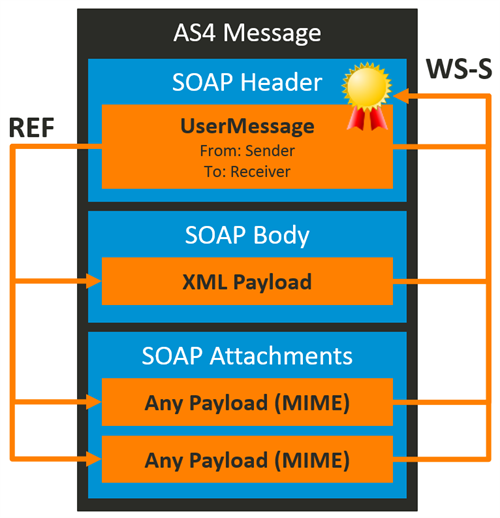
AS4 (Applicability Statement 4) is a modern secure web services-based communication protocol used for B2B data exchange, especially in EDI (Electronic Data Interchange). It is a successor to AS2, offering enhanced security, reliability, and flexibility using SOAP and web services standards.


Key Components of AS4 Architecture

Component

Description

SOAP Envelope

AS4 uses SOAP 1.2 for message structure.

ebMS Header

Metadata such as sender, receiver, message ID, and action.

Payload

Can be any type (XML, EDIFACT, X12, etc.).

WS-Security

Ensures message encryption, signature, and integrity.

Reliability

Built-in retry, duplicate detection, and delivery tracking.

P-Mode

Configuration setting that governs how messages are exchanged between partners (like service agreements).

Sunday, 13 July 2025

Understanding about SAP Port Configuration

In SAP EDI/IDoc processing, a port defines how IDocs are sent or received between systems,

Integration Scenarios

  • SAP to SAP

  • SAP to middleware (like Sterling, Boomi, Cleo, SAP PI/PO)

  • SAP to a file directory


Types of Ports in SAP:

Port Type

Description

tRFC (Transaction RFC)

Used for real-time IDoc transmission to another SAP system

File Port

Writes IDocs to a file (e.g., for middleware like Cleo, Seeburger, etc.)

ABAP-PI

Internal communication through ABAP proxy (used in SOA/web services)

XML HTTP

Sends IDocs as XML over HTTP(S)

Directory (EDI)

Sends IDoc to file system (common for outbound interfaces)


Where to Configure:

Use transaction WE21 to configure ports.


Why Port Is Important:

When SAP triggers an IDoc, it uses:

  • Partner profile (WE20)
  • Output type (e.g., BA00)
  • Port (defined in WE21)

If the port is misconfigured or missing, you'll get errors like:

  • Error while writing IDoc to file (EA084)
  • Port does not exist
  • No authorization to write file


Saturday, 14 June 2025

Understanding about AS2 MDN (Message Disposition Notification)

AS2 MDN (Message Disposition Notification):

AS2 MDN is an electronic receipt sent back to the sender after a successful (or failed) AS2 file transmission. It confirms message delivery and ensures non-repudiation (proof of delivery). It's like a return receipt in postal mail, but in the world of secure EDI communication.


AS2 Overview:

  • AS2 (Applicability Statement 2) is a protocol used to securely exchange EDI or other data over the internet using HTTP(S).

  • It supports:

    • Digital signatures

    • Encryption

    • Compression

    • MDN (Acknowledgement receipt)


MDN (Message Disposition Notification)

  • MDN is the acknowledgment that:

    • The message was received

    • The message was decrypted

    • The signature was verified

  • It may also include errors if the transmission fails.

There are two types:

  • Synchronous MDN (returned in the same HTTP connection)

  • Asynchronous MDN (returned in a separate HTTP request)


How Does an AS2 MDN Look?

An AS2 MDN is similar to an email delivery receipt and contains metadata like this:

Sample MDN (Human-readable)

Return-Path: <as2receiver@company.com>
Disposition: automatic-action/MDN-sent-automatically; processed Original-Recipient: rfc822;ReceiverAS2 Final-Recipient: rfc822;ReceiverAS2 Original-Message-ID: <AS2Sender1234@company.com> Received-Content-MIC: Wn5SxvSGz4ksklasdaasdas==, sha1
  • Disposition: indicates success or failure

  • Original-Message-ID: matches the ID of the original AS2 message

  • Received-Content-MIC: Message Integrity Check value


Sample MDN with Error (Failure)

Disposition: automatic-action/MDN-sent-automatically; failed/error: decryption-failed
Failure: The message could not be decrypted with the partner’s certificate.

Why MDN Is Important?

  • Provides non-repudiation of receipt

  • Helps in tracking and troubleshooting

  • Often required in HIPAA, retail, automotive, pharma, etc.

What are delimiters in EDI?

Delimiters are characters used to separate segments, data elements, and components within an EDI message. Example: BEG*00*NE*PO12345~ * — s...